
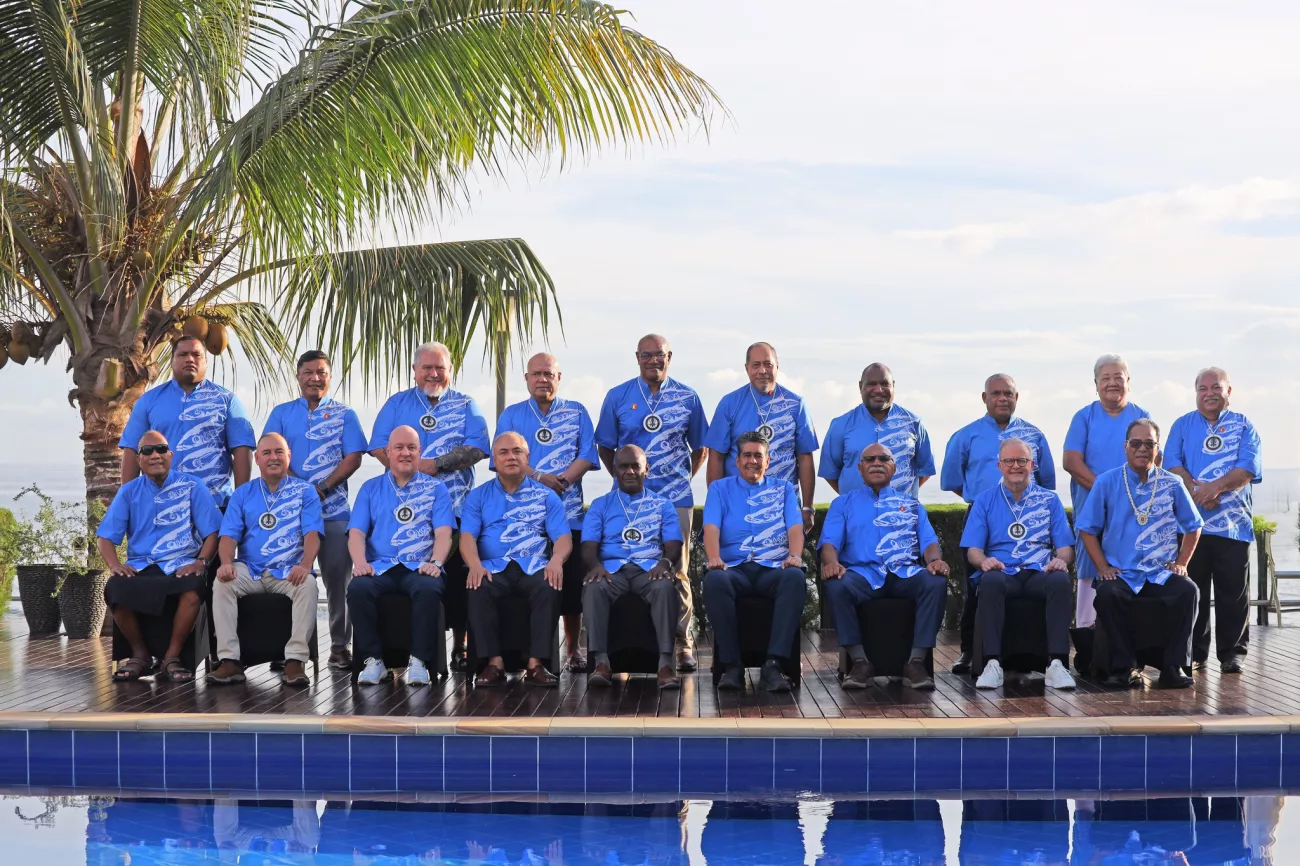
The 54th Pacific Islands Forum Leaders Meeting officially concluded yesterday with the close of the Leaders Retreat in Munda, Solomon Islands. Substantive discussions began earlier in the week with the Leaders plenary in Honiara, chaired by Hon. Jeremiah Manele, Prime Minister of Solomon Islands. Members noted that this year’s proceedings stood out for the calm and constructive manner in which discussions were held, a reflection of Prime Minister Manele’s diligent stewardship of both the plenary and Retreat.
The meeting also marked the conclusion of the Cook Islands’ tenure on the Forum Troika, a role held since 2022. During this time, the Cook Islands were closely involved in prioritising the operationalisation of the Troika mechanism, which has proven its value in strengthening continuity and collective leadership. Leaders noted the importance of the Troika as a key mechanism to take forward outcomes from this year’s meeting, including reforms under the Review of the Regional Architecture. At the start of the plenary, Leaders congratulated Prime Minister Manele on his assumption of the Forum Chairmanship and acknowledged the outgoing Chair, Hon. Aisake Eke, Prime Minister of Tonga, for his leadership and commitment to Pacific regionalism.
Among the most significant outcomes was the endorsement of the Blue Pacific Ocean of Peace Declaration, a landmark agreement that enjoyed high consensus across the membership. The Declaration affirms the equality and sovereignty of all Forum Members and commits to safeguarding peace for generations to come. Prime Minister Hon. Mark Brown reflected, “For the Cook Islands, this Declaration will serve both our national and regional interests, underpinning the security of our region through peace, stability and wellbeing. It is a powerful statement of our shared Pacific values, and we intend to carry it forward with purpose.”
Under the thematic area of Resources and Economic Development, Leaders celebrated the official establishment of the Pacific Resilience Facility as a Pacific-owned financing mechanism to deliver grants-based climate and disaster resilience funding directly to communities. Leaders also gave elevated support to the priorities of Smaller Island States, agreeing to mainstream a core set of deliverables into CROP agency work programmes. Together, these outcomes reflect the Pacific’s determination to create new economic opportunities that build resilience and improve the lives of all peoples of the region. Leaders further endorsed the Pacific Regional Labour Mobility Principles, recognising labour mobility as both a social and economic driver of development.
The Retreat advanced the region’s governance agenda through the Review of the Regional Architecture Phase 3 outcomes and the endorsement of the new Leaders Partnership Policy. Prime Minister Brown stated, “The strength of our Forum rests on our ability to adapt our institutions and sharpen our partnerships. The decisions taken on regional architecture and on the new Partnership Policy provide us with the tools to ensure that Pacific priorities are protected, Pacific voices remain at the centre, and partner engagement is structured and accountable.”
Leaders also underscored the importance of coordinated political advocacy, particularly in the lead-up to UNGA80 and COP31, reaffirming their unanimous support for a Pacific COP and celebrating the success of the International Court of Justice Advisory Opinion on climate change. They further commemorated the 40th anniversary of the Treaty of Rarotonga, first signed in the Cook Islands in 1985, reaffirming its central role in advancing a nuclear-free Pacific identity.
More broadly, Leaders recognised progress across all thematic areas of the 2050 Strategy, including ocean governance, sustainable fisheries, digital transformation, aviation connectivity, maritime boundaries, education, and health, ensuring that the Forum continues to deliver tangible outcomes for Pacific people. Under the People-Centred Development pillar, Leaders endorsed Gender Equality and Social Inclusion, and Early Childhood Development as standing agenda items, reinforcing the Pacific’s focus on equity and inclusion.
Finally, Leaders endorsed New Zealand to host the Forum Leaders Meeting in 2027 and French Polynesia in 2030. The outcomes of the 54th Forum reaffirm the strength of Pacific regionalism at a time of complex global challenges and demonstrate that the Forum continues to be the preeminent political body to advance the collective priorities of the Blue Pacific.